
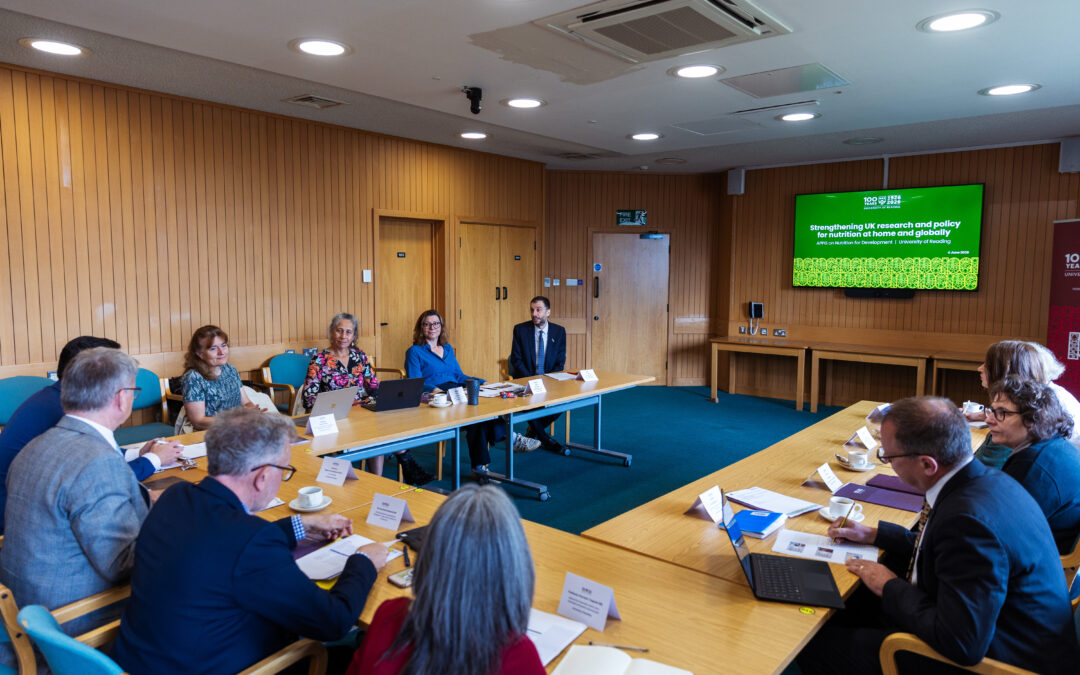
In June 2026, during the University of Reading’s centenary year, the APPG on Nutrition for Development visited the university to examine how its agrifood research is contributing to global efforts to address malnutrition. The visit was led by the APPG’s Co-Chair, Rt Hon David Mundell MP, and accompanied by Lord Oates, CEO of United Against Malnutrition & Hunger (UAMH).
The visit brought together parliamentarians, researchers and advocates to consider how evidence can inform stronger policy action on global nutrition. It built on the APPG’s recent engagement with the Rome Nutrition Week and the launch of the Global Nutrition Report, co-authored by Professor Giacomo Zanello, Professor in Food Economics and Health and Head of the Agri-Food Economics and Marketing Department at the University of Reading, who also serves as UAMH’s newest Expert Adviser.
The visit began with a panel discussion chaired by the university’s Vice-Chancellor, Professor Robert Van de Noort, who set out Reading’s role in shaping the future of farming and nutrition, describing the goal of healthier, more sustainable diets, including a focus on greater consumption of pulses and less meat.
Delegates then heard from Professor Lisa Methven, Associate Pro-Vice-Chancellor for Research (Agriculture, Food and Health), and Professor Simon Mortimer, Head of the School of Agriculture, Policy and Development, who outlined the vision of Agrifood Futures, which focuses on three linked priorities: resilient food systems for everyone; farming systems that work with nature and climate; and food that nourishes people and the planet. Its multidisciplinary work brings together social, economic and environmental scientists exploring issues including pest control, greenhouse gas emissions, food waste and microbial foods, alongside basic, clinical and industrial science supporting the pathway from discovery and testing to delivery and impact.
Professor Carol Wagstaff, Professor of Crop Quality for Health, presented work on improving food system equity, including research with cash-strapped communities and the strong return-on-investment case for nutrition research, where better diets support better health.
Professor Henny Osbahr then discussed research in India and Bangladesh challenging the conventional narrative on natural farming, in which farmers are improving soil health to achieve higher crop yields.
Professor Emily Black, Professor of Terrestrial Processes and Climate, highlighted the particular dependence of farmers in the Global South on variable weather and the need for more accurate forecasting. She noted that planting at the right time can increase yields by 10 per cent, while access to insurance, often through commercial seed companies, can enable farmers to take more productive risks.
Professor Zanello discussed research on the double burden of malnutrition among farming communities carrying out high levels of physical labour while consuming insufficient nutrition. He also presented work on locally produced formulations of ready-to-use therapeutic food (RUTF), including chickpeas in Ethiopia and soya beans in Nigeria.
Closing the panel discussion, Professor Parveen Yaqoob OBE, Deputy Vice-Chancellor and Pro-Vice-Chancellor for Research and Innovation, highlighted how the university invests in partnerships aimed at delivering policy impact. Rt Hon David Mundell MP welcomed this focus, stressing the need to communicate how nutrition research benefits both the UK and the wider world, particularly in the context of reduced public support for international development.
Speaking during the visit, Rt Hon David Mundell MP said: “I am committed to trying to ensure that the Global Nutrition Report secures parliamentary engagement.” He underlined the APPG’s purpose of keeping global nutrition on the parliamentary agenda and enabling members to hold government to account. Both Rt Hon David Mundell MP and Lord Oates reflecting on the importance of bringing research and politics together, referring to their recent participation in the APPG delegation to the Rome Nutrition Week.
The delegation then toured the university’s food processing plant, where Professor Colette Fagan of the Department of Food and Nutritional Sciences introduced the state-of-the-art facilities used for research into food processing technologies, quality and safety, including innovations utilising broad bean fibre to boost the nutrition of white bread.
The visit concluded with a sustainable, nutritious lunch prepared by the university’s catering team featuring dishes from their Menu for Change initiative, reflecting the university’s commitment to embedding health and sustainability across its food provision.