
One of the key objectives of the All-Party Parliamentary Group (APPG) on Nutrition for Development is to undertake cross-party Parliamentary visits to UK science and research hubs to understand examples of British innovation to address malnutrition and food insecurity.
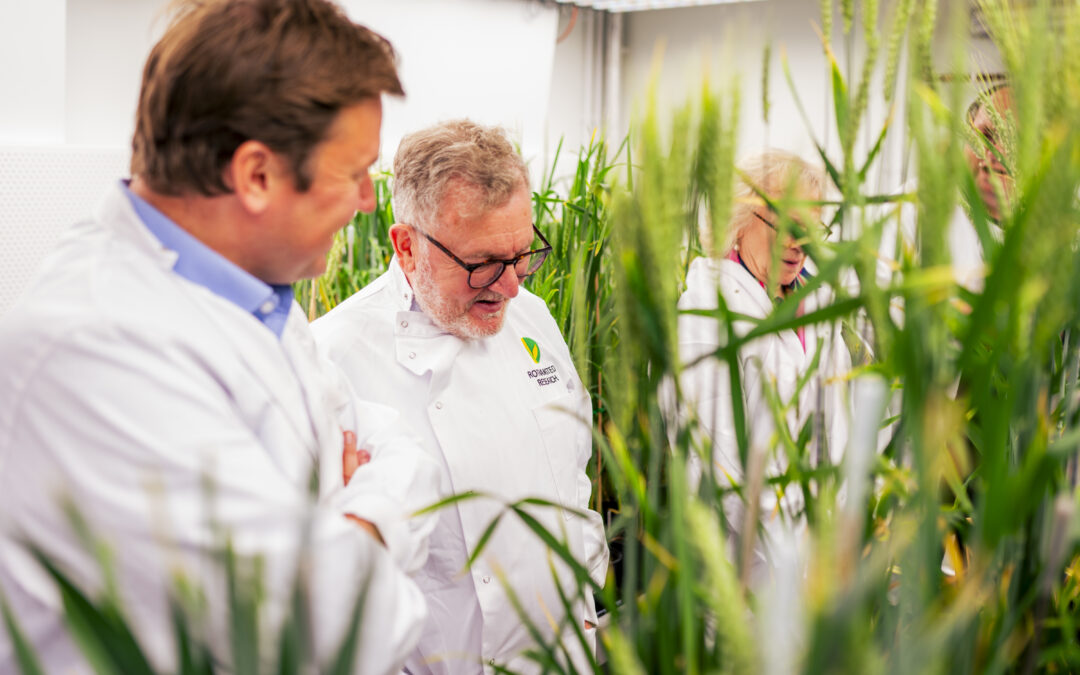
In June, the APPG’s Co-Chairs, David Mundell MP and Steve Race MP, and Members, Lord Cameron of Dillington and Baroness Hodgson of Abinger, visited Rothamsted Research’s headquarters in Harpenden. Lord Oates, Chief Executive of United Against Malnutrition and Hunger (UAMH), which provides the Secretariat for the APPG, also joined the visit.
Rothamsted Research is the longest-running agricultural research institute in the world with a proud history of ground-breaking discoveries. Founded in 1843 by Sir John Lawes and Sir Henry Gilbert, the institute pioneered modern agriculture and continues to make significant contributions to improving the sustainability of agri-food systems in the UK and internationally, through independent science and innovation, evolving around the interplay of science, politics, and agriculture. Rothamsted is strategically funded by the Biotechnology and Biological Sciences Research Council (BBSRC), with additional support from other national and international funding streams and from industry. They are also supported by the Lawes Agricultural Trust.
Rothamsted’s strength lies in their gene to field approach, which combines science and strategic research, interdisciplinary teams, and partnerships. Rothamsted is also home to three unique resources, open to researchers from all over the world: The Long-Term Experiments; Rothamsted Insect Survey; and the North Wyke Farm Platform. Rothamsted Research is also part of a network of institutions analysing plants’ metabolisms, researching whether this energy source can provide the world with what it currently seeks from fossil fuels.
During the visit, the delegation met with a number of Rothamsted Research’s academics – led by its CEO, Professor Angela Karp, a powerhouse of agricultural research knowledge and experimentation – to learn more about the role of British scientific research in improving the nutritional quality of crops for human and livestock consumption. Professor Martin Broadley, Science Director of Sustainable Soils and Crops, spoke about his collaboration with soil and crop scientists, human and animal nutritionists, and social scientists around the world on colour-coded maps to reveal how wheat and teff fortified with the mineral selenium can improve long-term health in Ethiopia and Malawi. He also explained how lysine-fortified wheat reduces inadequate levels of essential amino acid in rural households in India. Both nutrients are vital for a healthy immune system. Dr Zainab Oyetunde-Usman, a social scientist, explained how gathering information about human behaviour is essential to understanding the obstacles to households adopting more nutritious and climate resilient grains, because if a traditional or fortified grain takes more time in preparation, it is less likely to be taken up. And biochemist, Dr Alison Lovegrove, demonstrated how improving the nutritional value of wheat – consumed by most people one to three times a day – can be achieved without affecting taste through fibre-fortified white bread.
The delegation was also able to tour the site, including Rothamsted’s bioimaging facility, led by Dr Smita Kurup, a Plant Developmental Biologist. Her focus is on rice growing, which is both threatened by climate change and contributes to it. Seventy per cent of the world’s rice is cultivated in paddy fields, guzzling water, flooding land, and emitting the greenhouse gas methane; it takes 2,500 litres of water to produce one kilogram of paddy field rice. Dr Kurup’s team collaborates with international colleagues, notably the Philippine Rice Research Institute, analysing the genetic traits of seven hundred rice varieties, from Japan to India, for their sensitivity to temperature and light. The aim is to integrate better growing with higher yield, to produce climate-resilient varieties that require less water and boost food security.
The delegation also visited the Sample Archive, home to over 300,000 crop and soil samples – including ground and unground wheat grain, straw, soil, and herbage together with fertilisers, manures, and lime – dating back more than 175 years. About 1,200 crop and 200 soils samples are added annually.
Finally, the delegation visited the centres’ gene editing and transformation labs where Dr Mark Wilkinson, a Wheat Molecular Biologist, demonstrated gene manipulation by firing DNA into a cell under a microscope. His research aims to breed more disease-resistant wheat in a complex plant with forty-two chromosomes.
It was a packed and interesting day, which not only demonstrated the strength and breadth of the UK’s agricultural research and innovation but also highlighted the importance of maintaining consistent funding streams for research and development, given that research programmes such as these cannot easily be turned off and on.