
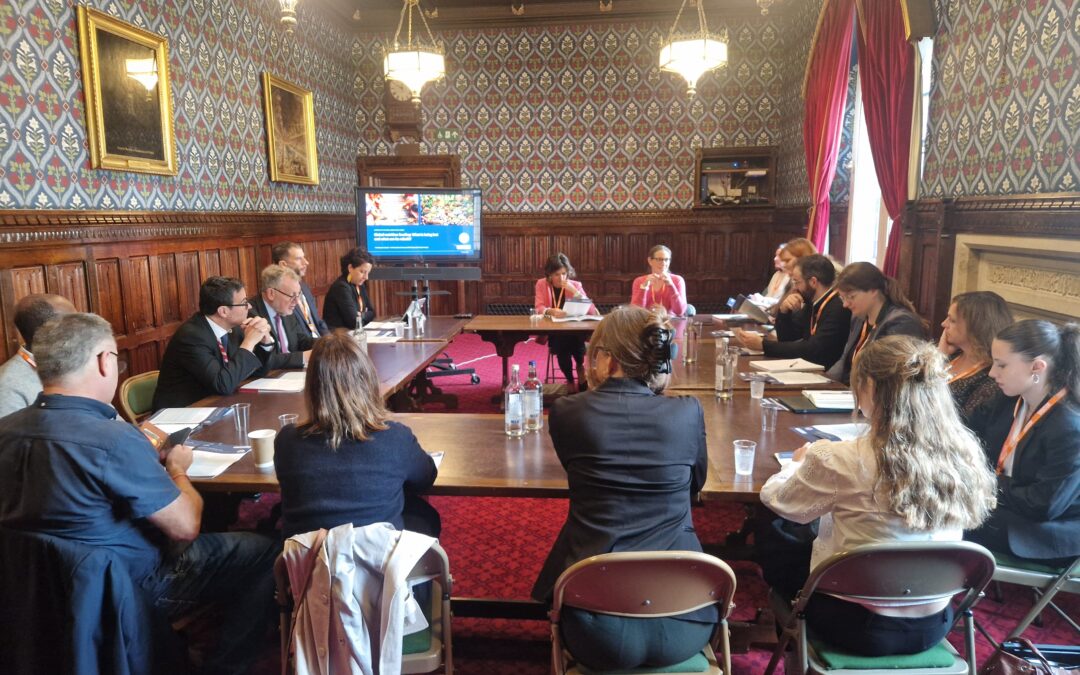
On Thursday 15 October, Rt Hon David Mundell MP, Co-Chair of the APPG on Nutrition for Development, chaired a roundtable event hosted by Steve Race MP and organised by United Against Malnutrition and Hunger (UAMH) and the Global Nutrition Report (GNR). The purpose of the event was to launch a joint policy briefing from UAMH and the GNR, and to share key findings from the GNR’s stakeholder survey and recommendations from the 2026 Global Nutrition Report (GNR).
The event drew on evidence from the GNR, the world’s leading independent assessment of the state of global nutrition. Together, its Country Nutrition Profiles, Nutrition Accountability Framework, and 2026 Thematic Report, connect evidence, commitments, and action on nutrition in a context of overlapping shocks.
Building on this evidence base, a new GNR-UAMH policy brief adds a frontline perspective. Drawing on a March-May 2026 survey of 409 stakeholders across more than 74 countries, the brief examines what is being lost, the risks if current trends continue, and how funders and policymakers can prevent temporary funding reductions from causing lasting damage.
In his opening remarks, David Mundell MP described his recent parliamentary delegation to Bangladesh, where 24 per cent of children under five are stunted and 12.5 per cent are wasted, with only 35 per cent of children aged six to 23 months receiving a minimally diverse diet and just 30 per cent achieving a minimally acceptable diet.
Professor Mariachiara Di Cesare and Professor Giacomo Zanello – who sits on the expert advisory committee at UAMH – then presented their findings from their stakeholder survey on the impact of global nutrition cuts, produced in collaboration with UAMH and Action Data.
Introducing the briefing, Professor Di Cesare emphasised that: “Investing in nutrition is not just a moral responsibility but an investment in growth and sustainable development.” Professor DI Cesare and Professor Zanello highlighted the significant contribution that UK-supported nutrition programmes have made in recent years, reaching almost 51 million children, women and adolescents between 2015 and 2019. However, they warned that recent reductions in development spending risk reversing hard-won progress.
Drawing on the findings of the 2026 Global Nutrition Report, Professor Zanello stressed that food systems and health systems cannot be addressed in isolation. The briefing calls for an integrated approach that ensures healthy diets for all, supported by strong leadership, governance, financing and research. Without these foundations, policy commitments may struggle to translate into meaningful results. The report also highlights three interconnected outcomes necessary for sustainable development: environmental sustainability and resilience, social equity, and economic prosperity. Achieving these objectives will be increasingly important as countries respond to the growing impacts of climate change.
While nutrition commitments are strong, speakers warned that many lack the financial resources required for implementation. Survey findings revealed that 78% of organisations supported by UK funding have been affected by recent funding reductions, with more than half reporting scaled-back activities and 15% forced to terminate nutrition programmes altogether. Alarmingly, one in five organisations surveyed does not expect to continue its nutrition work in the future.
Participants heard that many organisations are now focused on survival rather than adaptation, with funding cuts contributing to workforce reductions and a growing loss of expertise across the nutrition sector.
The briefing sets out seven priority areas where the UK could once again demonstrate global leadership on nutrition and help restore momentum towards international nutrition goals. The recommendations are:
- Develop diverse sources of finance
- Maximising funding for nutrition
- Use debt relief to protect nutrition investment
- Build equitable and accountable partnerships
- Longer funding cycles
- Support pre-agreed contingency finance
- Publish nutrition objectives
Opening the wider discussion, UAMH Chief Executive Lord Oates highlighted opportunities to position nutrition within sustainable financing mechanisms, including climate finance, particularly as countries face the long-term impacts of climate shocks such as El Niño. The discussion then opened up to the Chair of the Environment, Food and Rural Affairs (EFRA) Select Committee, Alistair Carmichael MP, who emphasised the value of partnerships between Government, researchers and scientific institutions. He praised the work of organisations including the John Innes Centre and Rothamsted Research and noted the UK’s strengths in translating scientific expertise into practical solutions. Earlier this year, UAMH brought together leading research institutions in Parliament to mark British Science Week, showcasing the emerging scientific developments aimed at improving how food is produced, distributed, and consumed.
Ian Byrne MP highlighted the importance of restoring the UK’s commitment to spending 0.7 per cent of Gross National Income (GNI) on Official Development Assistance (ODA), arguing that long-term investment is essential to addressing the root causes of malnutrition and food insecurity. Geraldine O’Callaghan, Director of the World Food Programme in London, also contributed to the discussion, highlighting the importance of malnutrition prevention as an innovative investment, where the benefits provide significant value for money.
Representatives from the Foreign, Commonwealth and Development Office (FCDO) welcomed the findings of the Global Nutrition Report and noted the strong alignment between the report’s recommendations and the priorities currently being considered by the department’s nutrition team. They stressed that effective action on nutrition requires a genuinely multi-sectoral approach and reaffirmed the importance of prevention. Participants heard that preventing malnutrition must remain a priority, not only because surviving malnutrition can have lifelong consequences for children, but also because nutrition interventions play a crucial role in preventing communities from sliding into humanitarian crisis and in building long-term resilience.
The discussion also highlighted the role of the Child Nutrition Fund (CNF) in attracting new sources of investment for nutrition through philanthropic partnerships. Speakers noted that relatively modest investments through the Fund have successfully leveraged additional financing and welcomed the Government’s positive reception of the briefing’s seven recommendations.
Closing the event, Lord Oates reiterated the need for renewed political leadership on global nutrition, warning that the costs of inaction would be felt for generations. He called on policymakers, donors and international partners to ensure that nutrition remains central to efforts to improve health, strengthen resilience and support sustainable development worldwide.