
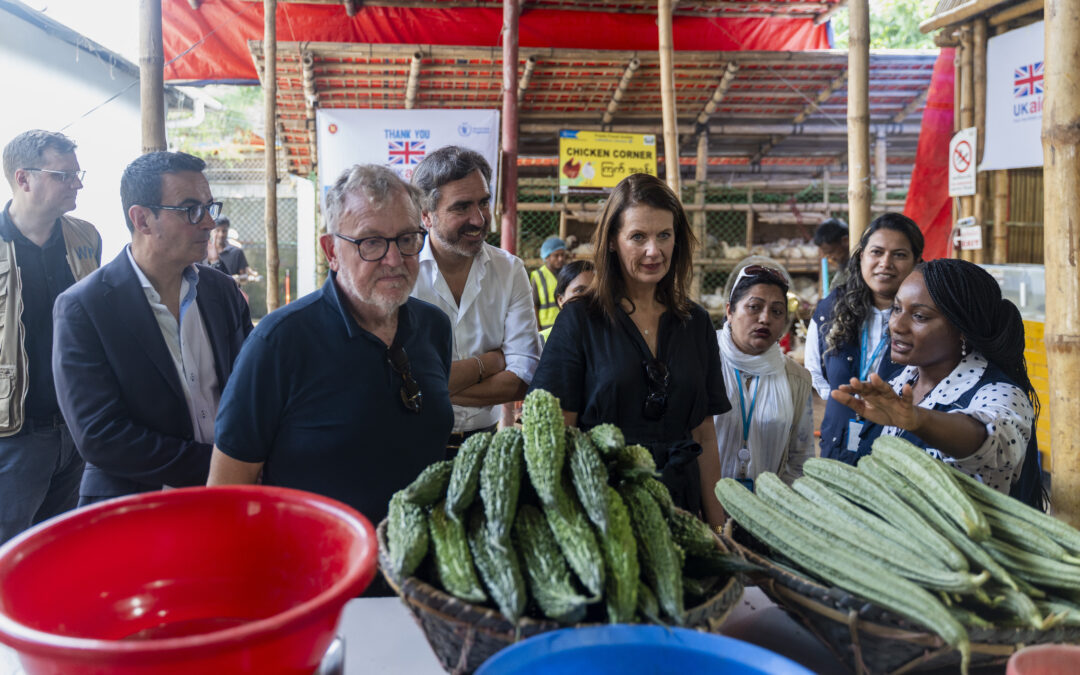
In October, the All-Party Parliamentary Group (APPG) on Nutrition for Development’s Co-Chair, Rt Hon David Mundell MP, Vice-Chair, Monica Harding MP, and member, Alan Gemmell MP, visited Dhaka and Cox’s Bazar in Bangladesh to learn more about the state of, and challenges for, nutrition in the country and to see effective interventions at community level. Lord Oates, Chief Executive at United Against Malnutrition and Hunger (UAMH), and Martha Varney, Senior Adviser at UAMH, which provides the Secretariat for the APPG, also joined the visit.
Bangladesh has made significant progress in reducing malnutrition over the past three decades, particularly in reducing rates of stunting and underweight among children, and in reducing newborn and child mortality rates. The Government of Bangladesh has made nutrition a national priority, including through developing a National Nutrition Plan. However, persistent challenges remain, especially for women and children under five. These challenges are exacerbated by climate-related shocks, food insecurity, rising food prices, service disruptions, and humanitarian needs. Nearly half of all pregnant women in Bangladesh suffer from anaemia, 26 per cent of children under five are affected by stunting, and 11 per cent are affected by wasting. Forty per cent of households suffer from significant micronutrient deficiencies and only 35 per cent of Bangladeshi children aged six to 23 months receive a minimally diverse diet.
In addition, humanitarian needs among the nearly 1.2 million Rohingya refugees in Cox’s Bazar and on Bhasan Char remain acute. 30 per cent of refugees were estimated to face crisis-level food insecurity or worse between May and August 2026, a figure which is expected to rise to 35 per cent by the end of the year.
During the visit, the delegation visited several projects, programmes, and organisations working on addressing malnutrition and food insecurity in Bangladesh.
In Dhaka, the delegation visited Korail high-density settlement with the World Food Programme (WFP) to see how nutrition-sensitive social protection supports vulnerable women and children through cash assistance, nutrition counselling, and access to essential services. Korail is the largest informal settlement in Dhaka and one of Bangladesh’s most visible examples of urban poverty and vulnerability. Despite its proximity to major commercial and economic hubs, Korail is characterised by extremely high population density, overcrowded housing, poor housing conditions, high levels of food insecurity, inadequate sanitation, and limited access to maternal and child health services. The delegation met with mothers attending an educational session in the flagship Mother and Child Benefit Programme (MCBP), and heard about their experiences and challenges, as well as how the WFP is supporting better nutrition from pregnancy to early childhood.
The delegation travelled to the Rohingya camps in Cox’s Bazar and neighbouring local host communities with WFP to see integrated Rohingya response efforts. This included a visit to Goaliapalong Aggregation Centre and weekly market to meet local farmers from host communities. The delegation heard how market access, community grain storage, and other support can strengthen livelihoods. The delegation also visited an e-voucher outlet to learn how Rohingya refugee families access food through WFP’s monthly food assistance programme, offering diverse and nutritious products together choice and dignity. Finally the delegation visited an Integrated Nutrition Facility to learn about WFP and partners’ work in improving access to essential services and integrating nutrition and health services within the camps.
In Dhaka, the delegation also met with the International Centre for Diarrhoeal Disease Research (iccdr,b) at icddr,b’s Dhaka Hospital – the world’s largest diarrhoeal disease hospital. The delegation had a tour of the hospital where treatment is provided free of charge, and nutrition research facilities, including the Nutrition Rehabilitation Unit, where children with severe acute malnutrition are treated through carefully designed therapeutic diets, clinical management, and counselling. Many children treated for malnutrition at the hospital recover within a matter of weeks. The tour was followed by a meeting with icddr,b’s Senior Leadership Team and scientists from the Nutrition Research Division, as well as a wider discussion with civil society stakeholders on the overall nutrition and food security situation in Bangladesh.
The delegation also visited Mirpur Nutrition Facility, Renata’s dedicated facility for nutritional products. Renata pharmaceuticals is one of the largest and fastest growing pharmaceutical companies in Bangladesh and manufactures products such as micronutrient powder for children, multiple micronutrient supplementation (MMS) tablets for pregnant women, and oral rehydration saline to improve the nutrition deficiencies of children and mothers across Bangladesh and the world.
In Cox’s Bazar, the delegation visited a local pharmacy and a community mobilisation meeting led by Social Marketing Company (SMC) with Sight and Life, where mothers and expectant mothers receive nutrition counselling and pregnancy care services, and where tablets, such as those manufactured at Mirpur Nutrition Facility, are distributed.
The delegation held a series of meetings alongside these field visits. To start and round off the visit, the delegation met with the British High Commission Dhaka to understand more about the UK’s work on nutrition in Bangladesh. At the Bangladesh Secretariat, they met with Hon. Minister Sardar Md. Sakhawat Husain MP, Minister for Health and Family Welfare, to discuss the progress of Bangladesh’s health sector, challenges, ongoing activities, and future. In addition, the delegation visited the Bangladesh National Nutrition Council (BNNC) to join a meeting with government representatives, civil society, business, and youth representatives from the Scaling Up Nutrition (SUN) Movement Bangladesh to understand more about the reach and scope of the SUN networks across the country, including efforts to empower youth to lead nutrition advocacy. The delegation also met with the World Bank Group to discuss the broader macroeconomic context and state capability issues for the health and nutrition sectors in the country.
In Dhaka, the delegation met with senior representatives from UNICEF Bangladesh, the WFP, and the World Health Organization (WHO) to learn about their collaborative work on the Child Nutrition Fund (CNF) and the Joint UN Initiative for the Prevention of Wasting (JUNIPr) – a five-year initiative aimed at accelerating the prevention of child wasting. Both the CNF and JUNIPr are supported by funding from the FCDO.
Finally, the delegation met with local, national, and international non-governmental organisations (NGOs) working to improve nutrition in Bangladesh, including BRAC, Concern Worldwide Bangladesh, and the Society for Health Extension and Development (SHED), a local NGO working in Cox’s Bazar to transform the lives, livelihoods, and skills of resource-poor.
Parliamentary delegations to high burden countries are vital to the work of the APPG, enabling members to understand more about the global state of nutrition and see first-hand the impact of malnutrition as well as local solutions to address malnutrition and food insecurity. The delegation was honoured to meet so many inspiring and dedicated people during the visit, to from those affected, and to celebrate the incredible work of regional and national governments, NGOs and civil society, healthcare workers, and other partners who are the backbone of the response.