
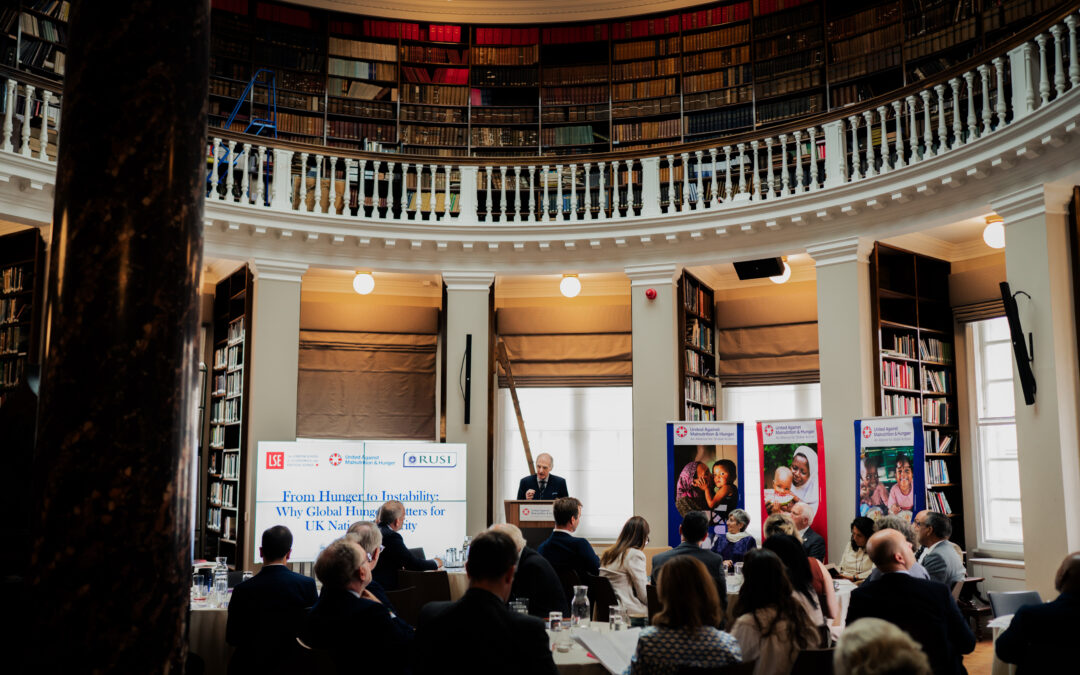
On Wednesday 2 September, members of the APPG joined United Against Malnutrition and Hunger (UAMH) at the Royal United Service Institute (RUSI) for the launch of the London School of Economics and Political Science (LSE) and UAMH’s new report From Hunger to Instability: Why Global Hunger Matters for UK National Security.
The launch brought together parliamentarians and sector leaders to discuss why hunger and malnutrition need to play a greater role in conversations about UK security planning, with Lord Jock Stirrup, former Chief of the Defence Staff and Marshal of the Royal Air Force, delivering the keynote address. Lord Stirrup was joined by speakers Rosalind Roberts (Director of Research, RUSI), Air Marshal (Ret’d) Sir Graham Stacey KBE CB (UAMH Expert Adviser), and Professor Stuart Gordon (Report Author and Former RAF and British Army Officer), alongside panelists Dr Sara Pantuliano (Chief Executive, ODI Global), and Dr Sima Samar (Nobel Peace Prize Nominee, Founder of the Shuhada Organisation, and former Minister of Women’s Affairs in the Afghan Interim Administration).
Against the backdrop of a changing security landscape – in which food security and food supply chains are gaining prominence in the UK Government’s National Security Strategy and entering wider policy conversations – Parliamentarians are keen to engage with the armed forces to understand the role malnutrition plays in driving instability and conflict.
Co-Chair of the All-Party Parliamentary Group on Nutrition for Development, Rt Hon David Mundell MP, was in attendance, alongside APPG Vice-Chair Monica Harding MP. They were joined by parliamentarians Steve Race MP, Lord Mohammed of Tinsley, Dr Brian Mathew MP, Lord Purvis of Tweed, and, Chair of the International Development Select Committee, Sarah Champion MP.
The discussion drew primarily on a recent report by the London School of Economic and Political Science (LSE), commissioned by United Against Malnutrition & Hunger (UAMH) – From Hunger to Instability: Why Global Hunger Matters for UK National Security. The report finds that malnutrition and hunger can drive instability and conflict as well as result from them. Hunger and malnutrition are therefore not only humanitarian, health and development concerns; they are also national security concerns. Treating hunger prevention as part of preventive security policy is both a humanitarian imperative and a strategic necessity.
Among its recommendations, the report calls on UK policymakers to: expand predictable and anticipatory financing so that support can be scaled before food stress becomes politicised; incorporate indicators such as food-price volatility, harvest failure, market disruption and malnutrition into early-warning assessments; and support locally led responses and shock-responsive social protection.
Following the keynote address from Lord Stirrup and opening remarks from panelists, David Mundell, Co-Chair of the APPG on Nutrition for Development, offered comments on the importance of UK Parliamentarians repeating the messages highlighted during the event as part of efforts to recognise global malnutrition as a security priority.
The APPG will continue to press for hunger and malnutrition to be recognised as a national security priority, working alongside parliamentarians, the Armed Forces, and sector partners to advocate for the report’s recommendations.
The full report, From Hunger to Instability: Why Global Hunger Matters for UK National Security, is available to read here.